

You’re one round away from the win. Your team has the advantage, your aim is locked in, and then it happens. The screen freezes, your character stops responding, and by the time the connection catches up, the match is over.
In short, lag cost you the game.
Most competitive gamers know this frustration all too well. A 2025 nationwide study by Liquid Web found that 78% of gamers have quit a match in frustration due to high latency during gameplay.
That number isn’t surprising to anyone who has watched a killcam reveal they were already dead before they even pulled the trigger.
The type of connection that runs into your home has more to do with that experience than most people realize. Understanding how fiber internet reduces lag, improves response times, and keeps your gameplay consistent is the first step toward fixing it.
In this post, you’ll learn:
- Why internet connection type has a direct impact on gaming performance
- How fiber optic internet delivers lower latency than cable
- Why upload speed for gaming matters more than most players think
- How to get the most out of your setup with the best WiFi setup for gaming
Why Your Internet Connection Type Matters for Gaming
Most gaming discussions focus on hardware like graphics cards, monitors, headsets, and peripherals. But the internet connection feeding all of that is just as important, and it’s the piece most players overlook until something goes wrong.
What Happens When the Connection Struggles
High latency means the data traveling between your device and the game server is taking too long to make the round trip. That delay shows up as lag, rubbery movement, and actions that register late. Even a fast connection is frustrating if latency is inconsistent.
Why Not All Internet Is Built the Same
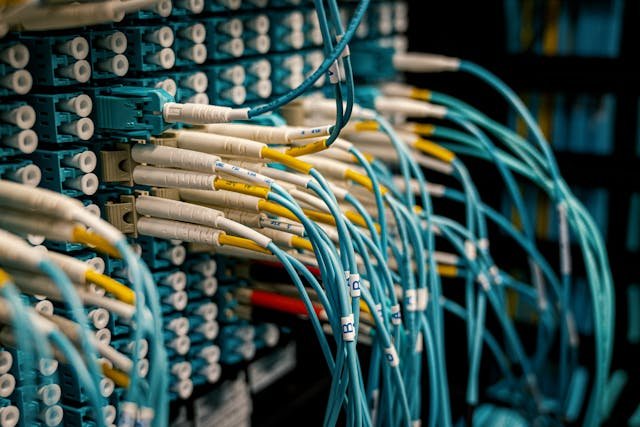
Cable internet relies on copper wiring that degrades over distance and slows down during peak hours. Fiber optic internet sends data as pulses of light through glass strands, staying stable and fast regardless of network traffic.
In competitive gaming, that is the distinction between winning and watching a killcam.
How Fiber Optic Internet Reduces Lag
The type of connection running into your home determines how quickly data moves between your device and the game server. Fiber optic internet uses light-speed transmission through glass strands, which means lower ping and a more consistent connection under pressure.
Speed, Latency, and Consistency
Fiber delivers symmetrical gigabit internet speeds in both directions, keeping gameplay smooth even when multiple devices are active. Cable connections share bandwidth with neighboring homes, which increases latency during peak hours.
That inconsistency is what separates a reliable, low-latency internet connection from one that performs well only under ideal conditions.
Upload Speed for Gaming
Every input you send travels upstream to the server first. Upload speed matters just as much as download speed for gaming. According to the Fiber Broadband Association, modern gaming is highly sensitive to latency and packet loss.
Fiber’s symmetric performance and low-latency potential make it uniquely suited for serious online gaming.
Is Fiber Internet Good for Gaming
The short answer is yes, and the longer answer comes down to what actually happens during a match. Raw download speed is only part of the picture. What separates a smooth gaming experience from a frustrating one is how consistently the connection performs under real conditions.
What the Numbers Actually Mean
Ping, measured in milliseconds, is the metric that matters most for competitive play. Fiber optic internet routinely delivers a ping in the 5 to 15ms range, while cable connections typically run 20 to 40ms and spike higher during peak hours. For anyone chasing sub-20ms performance, that gap is significant.
How Fiber Compares in Real Gameplay
As PC Gamer confirms, fiber connections deliver faster downloads, lower latency, and less jitter than cable, making fiber the best internet for competitive gaming. Jitter, the variation in latency between packets, is where cable connections lose ground fastest.
How to Reduce Lag in Online Games
Even the best fiber internet connection loses ground when the home setup works against it. A few simple adjustments on your end make a real difference in how that connection performs during a match.
Wired Connections and Router Placement
A wired Ethernet connection removes the variability that WiFi introduces, noticeably lowering ping in most setups. Router placement matters too. Keeping it central, away from walls and interference sources, keeps the signal strong for every device in the home.
For the best WiFi setup for gaming, these two adjustments alone often produce immediate results.
Choosing the Best ISP for Online Gaming
The best ISP for online gaming prioritizes low latency and consistent speeds over just boasting high download speeds. Fiber-based providers deliver on both counts over cable alternatives. Matching a gigabit internet plan to a solid home setup is where competitive gaming performance comes together.
The Connection Behind Every Competitive Edge
Lag is rarely about the game and almost always about the connection. Reducing it comes down to two things: the right internet technology and a home setup that doesn’t work against it. For competitive players, those decisions have a direct impact on every match.
Fiber optic internet has become the standard for serious online gaming because it delivers on the metrics that matter most. Low latency, consistent speeds, and symmetrical upload performance all come standard with a quality fiber internet connection.
If your current setup is holding your gameplay back, it may be time to explore what fiber options are available in your area. The gap between a cable connection and a true fiber optic internet shows up every time you pull the trigger.
Getting that edge starts with the infrastructure running into your home.